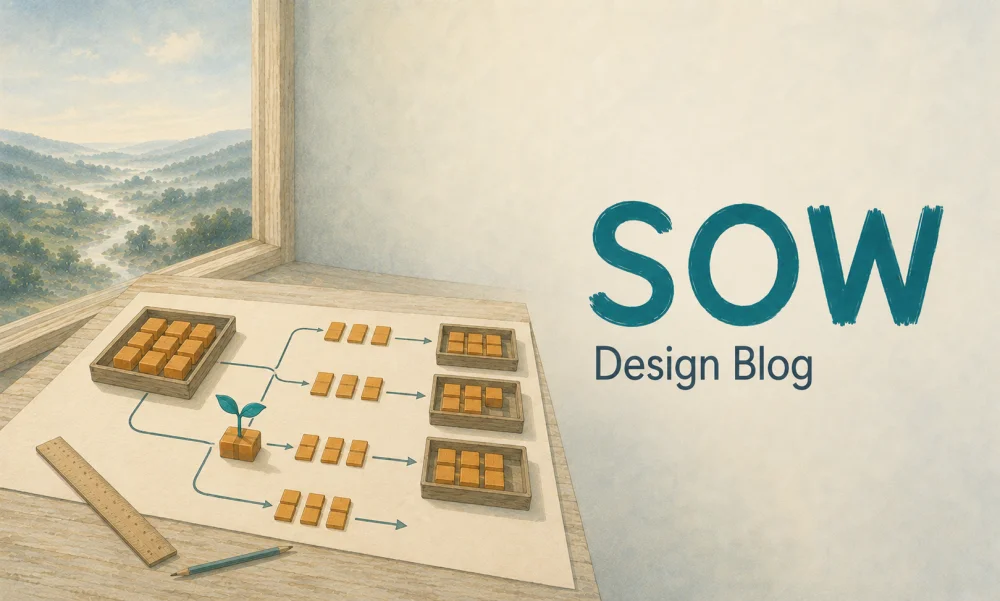

This decision was drafted on 2026-08-05 and shipped in SOW v0.2.0 on 2026-08-08. SOW 0.5.0 still uses this layout. Each Repository stores one package tree and lets its distribution views reference that tree.
Decision
Each SOW Repository owns one public tree:
The diagram shows an RPM view. APT indexes use dists/<dist>/main/binary-<architecture>/;
its Release files sit at dists/<dist>/.
A package object has one payload path inside one Repository. Adding the same object to several Dists or architecture views adds membership and metadata references.
The complete pool/ + dists/ root is the supported copy, static-hosting, authorization,
and publication unit. A single architecture leaf is a client view, not a complete package repository.
From the C2 development layout to v0.2.0
An earlier pre-release C2 development layout stored each package once in a root Pool, then
created package hardlinks inside RPM views. This gave selected reposync clients a
self-contained leaf without duplicating local bytes.
Hardlinks saved local disk space, but had costs elsewhere:
- object storage expands each path into a separate key, so aliases duplicate payloads;
- archives and cross-filesystem copies can expand or lose hardlink identity;
- a package path inside a view looks independent, although the Repository still owns the file;
- retention and garbage collection can confuse link counts with package references;
- the repository layout has to follow a particular mirror tool’s output-directory rules.
Before v0.2.0 was tagged, the final single-payload design removed package aliases from RPM views. The archived C2 documents describe that development line.
How metadata reaches the Pool
APT already treats Filename as an archive-root-relative path, so a package entry names its
pool path directly:
For RPM, each <location href> is computed from the actual view directory to the
Pool path:
The renderer and checker share the same path function. It calculates the relative path and escapes the file name. It then resolves the result and checks that it points to the original package inside the Repository.
This keeps the public tree relocatable. Keep the relative locations of pool/ and dists/ when you copy the repository.
Then the same metadata works under another filesystem directory, HTTP origin, bucket, or prefix.
Rejected alternatives
| Alternative | Why it was not used |
|---|---|
| Package hardlink/copy in every RPM view | Creates path aliases and duplicate object keys |
| Symlinked payloads | Object storage does not support them; static servers and archives handle them differently |
Leading /pool/... href |
Different clients interpret it as host-root or repository-relative; it also breaks non-root prefixes |
Absolute URL or xml:base |
Binds metadata to one origin and prevents unchanged relocation |
| CDN rewrite or redirect objects | Requires extra routing configuration for the repository |
| Workspace- or bucket-global pool | Requires cross-Repository coordination for locks, retention, and deletion |
Mirror-tool compatibility is an export concern
An ordinary package client only needs to resolve metadata references and fetch package bytes. A mirror tool may additionally insist that every package be stored below the view directory it was given.
For consumers that require a standalone RPM leaf, use sow export rpm-leaf. It creates
a directory outside the Repository with package files and regenerated local metadata. Copy is the default.
Use --hardlink on the same filesystem and keep exported package files read-only, because
writing through a hardlink also changes the Pool file. The export is not a Generation, publication source, membership owner, or garbage
collection root.
Client and mirror-tool results remain in the
compatibility matrix. Use
sow check to verify local paths, digests, and file references.
Use the listed client tests to check package installation and mirroring.
Consequences
- Package identity, membership, Generation, retention, and local GC stay Repository-scoped.
- Publication attempts, checkpoints, remote inventory, grace, and deletion evidence stay target-prefix-scoped.
- Each package file maps to one static object key.
- Before deleting a payload, check its references and file identity. Do not use hardlink count to determine whether it is still needed.
- Copy the Repository root, or use the export command to create a standalone RPM architecture directory.
The current mechanism is documented in Pool & Metadata Views, while System model and Publication and recovery define the surrounding ownership and lifecycle rules.